

Why Do I Need A Website For My Business?
September 19, 2026
by Thomas W. Pohl, Owner of Cybervision Web
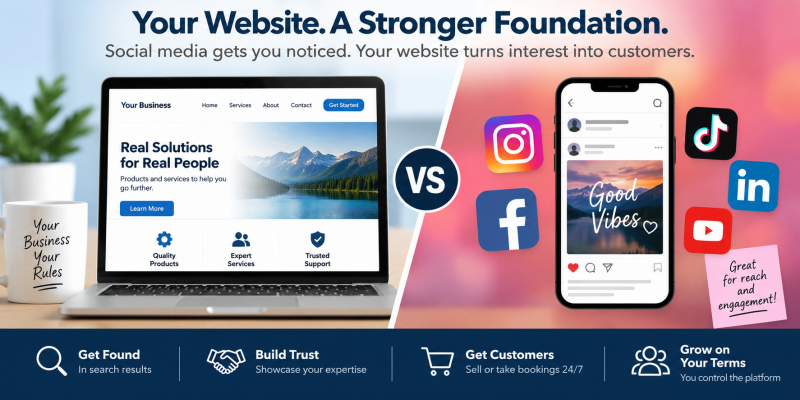
Companies and individuals who only offer their products and services exclusively through social media platforms such as Facebook and Facebook Marketplace are at a disadvantage when compared to their competition who have a website.
A website and social media serve different purposes. For a business selling products or services, social media is excellent for getting attention and starting relationships, while a website is generally better for establishing credibility, explaining the offer, capturing search traffic, and converting visitors into customers. The table below gives us a great comparison of the two.
| WEBSITE | SOCIAL MEDIA ONLY |
|---|---|
| You control the platform | The social network controls the platform |
| Your branding and presentation | Limited by the platform's design |
| Can sell directly 24/7 | Selling options depend on platform features |
| Can rank in Google and other search engines | Posts often have a short discovery lifespan |
| Can be optimized for AI/answer engines | Less control over how AI systems access your information |
| Detailed product/service pages | Usually shorter-form information |
| Professional domain/email reinforces credibility | Customer remains inside someone else's ecosystem |
| Build your own email/customer database | Followers belong to the platform |
| Detailed analytics and conversion tracking | Analytics are controlled by the platform |
| No algorithm determines whether visitors can see your content | Organic reach can depend heavily on algorithms |
| Can integrate booking, payments, forms, CRM, etc. | Integrations are more restricted |
The Biggest Advantage: Ownership and Control
When you build a following exclusively on Facebook, Instagram, TikTok, LinkedIn, or another social network, you're essentially building your business on rented property.
The platform can change its algorithm, reduce organic reach, change its rules, discontinue features, suspend an account, or eventually decline in popularity.
With your own website, you control the property. You control the domain, content, branding, navigation, calls to action, sales process, and customer experience.
A Website Can Capture Customers Who Aren't Following You
This is especially important.
Suppose someone searches:
"web designer for small business near me"
That person may have never heard of your company and may never have encountered one of your social posts. A properly optimized website gives your business an opportunity to appear when that person is actively looking for the service you provide.
That makes SEO—and increasingly AEO (Answer Engine Optimization)—a major advantage of having a website.
Websites are Much Better for Explaining Complex Services
Social media is optimized for scrolling.
A website is optimized for exploration.
For a service business such as Cybervision Web, for example, someone can move through a deliberate path:
Homepage → Services → Portfolio → Testimonials → About → Pricing/Consultation → Contact
You can answer objections and establish credibility throughout that journey.
That's much harder to accomplish through a collection of Facebook or Instagram posts.
Websites Can Create a More Professional First Impression
Someone who discovers a company on social media will often search for its website before contacting it.
A professional website gives you space to show things such as your history, portfolio, testimonials, services, FAQs, contact information, policies, credentials and detailed information about the company.
For a small business or nonprofit, that can substantially reinforce credibility. I have heard many stories of people getting ripped off on Facebook Marketplace. You never know who credible those individual are.
A website is your corporate image! Remember, you will only have one chance to make a first impression. What do you that impression to be?
Proper Role of Social Media
Social media attracts attention and builds relationships.
Your website becomes the central hub where people can learn, evaluate, trust, inquire, book or buy.
Then email and social media can keep the relationship going.
Social media should supplement your online presence, not be your only online presence.